1st Sunday of Advent YearPresent is a blessing……”Maranatha”Is 63:16b-17,19b, 64:2-7,
1Cor1:3-9,
Mk13:33-37Dear Sisters and brothers in Christ Jesus, We have lot of newness today. It is the beginning of a new liturgical year. It is the first week of a new season of Advent, we begin a fresh year of consecrated life and new preparations for another year of Christmas Celebration. All these enable us to breathe a lot of freshness and brightness in our present reality of life. Every Eucharist invites us to make ourselves present in the presence of Jesus who makes himself present on the altar in the Eucharist. We may continue to be innovative to celebrate the blessings of the present moment.
Mark and John were good companions; they happened to meet at the market place during their vacation period. Mark said, “I am going to Church for a special prayer service. Do you want to join me?” John responded, saying, “No”, then he said, “I am going for a movie, do you wish to come with me?” Mark said, “no, it is ok.” Both left the place. After a week they met in a store, and then both said in one voice the same phrase, what would be the sentence? Both said “I wish I would have come with you”. It reveals that they never lived in the present. Mark went to church for the prayer service, but he was dreaming about movie and his thoughts were that he should have gone to a movie with John, and that he might think I am trying to be pious. John went to the movie theater and worried that he should have joined Mark and gone to church. He was worried how Mark would think about his missing the prayer service. Both of them never lived in the present moment.
We rarely live in our present moment. Either we are worried about out past events or scared about unknown future. I wish I should have bought that house five years ago; I should have not sold my parents’ property. How dare my sister could do that to me? I cannot accept the separation of my daughter’s first marriage; then how will I be approving of her new marriage? These are past worries where we spend most of our present time. We cannot change the past history, but we can re-write the history in the present.
Standing in the Grand Canyon if you say, “it is awesome spot I wish to come here someday” then I failed to realize that I am here in the present moment, and that I need to be enjoying this moment. “I hope I don’t run out of cookies when my grandchildren come. It is going be very chilly this weekend, I need to have extra blankets and stay in. Our conversation and thoughts are about future anxieties. We stress ourselves with the unknown future thoughts but we fail to recognize our energies in the present time. The readings of this first Sunday of Advent, invite us to recognize God’s presence, to explore His blessings and to celebrate in this present moment.
In the first reading, the prophet Isaiah offers the lamentation of the People of Israel. Jerusalem was destroyed and people were taken as captives by the Babylonians. After 70 years of exile, when they were liberated by the Persian emperor, they lamented, looking for their future life and their journey back to Jerusalem. They said that we are like unclean and polluted garments and withered leaves, then they call out to Him, we have no one but you alone. You are our ever understanding, caring and protecting father and you are the potter, we are your end results, once again shape our life because your are the potter who continues to form our life, by being in our present, among us and with us. Do we lament about our past, or do we recognize God and His blessings in our present time?
In the gospel, Mark is giving the message of Jesus to the New Christian community of Palestine and Rome to be in the present, alert and awake as the gate keeper, because the Romans occupied the Jewish land and controlled Palestine. The Christian community was hoping for the return of Jesus, but hope was lost and they feared that the Roman forces would destroy the Jerusalem temple and city, and then they would be facing the end of the world; so some were planning to revolt. In this situation they were told Jesus would come like the master at any time, and no one could guess the time; so not to revolt, rather continue your life of faith with alertness and wakefulness in the present, even in the midst of persecutions.
How did Jesus want the life of Early Christians and His apostles to be during the destruction of Jerusalem temple by Roman Empire in 70 AD? How would they need to approach the persecutions? Jesus strongly says, don’t allow your thoughts to focus on the future, this will not be the end times. He used imperative sentences 19 times in this chapter, such as: “be careful, be watchful, be on your guard, and be alert” etc. He told them not to be deceived by false leaders who will distract you that these are signs of near future end signs. Don’t be lazy and hopeless that I am gone. He assures that he is like the master who wakes with then in their life journey, he watches them and he is like the gate-keeper: ever awake and observes their goodness of life.
Jesus commands them with love to be alert, conscious, and to be awake to the destruction, persecution, trails and suffering, by being courageous witnesses in the present. Jesus prepares them in his physical absence the time between ascension and Parousia, to live fully with commitment. He calls us to call and claim the presence of Jesus in us, among us and with us. Present is beautiful and challenging.
Am I aware that I am so immersed in the false reality of video games in the present reality…
Am I conscious that I am fully involved in putting ‘likes’ in Facebook friends who may not exist at all…
Am I alert that innocents are victimized from human trafficking around me…..
I missed following the blessings, yet never fail to respond to an unknown twitter friend….
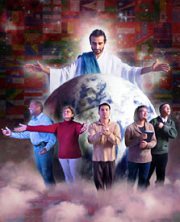
The Early Christian communities struggled with the same difficulties of staying in the present moment, and were offered a solution to move from the past thoughts of worries and future dream of anxiety. What is that new method? They were given a phrase “Maranatha” to use at the persecution, among the false leaders and even in the community celebration of Eucharist. Maranatha is an Aramaic word for “Jesus is coming, or Jesus has come, or Jesus is here. The Romans compelled all to declare Caesar as God. The Early Christians knew that Jesus Christ is the only Lord. They were considered as traitors, and persecuted by Romans. Here the common greeting of “maranatha” brought life and hope among them. They started involving actively. This Maranatha was replaced with the Jewish greeting, Shalom. People greeted each other with maranatha instead of good morning; even in liturgy, the sharing of peace was replaced by Maranatha.
Shall we say Jesus is here and Jesus has come, by being actively involved in the present commitment of our life? Presence is beautiful, presence is real, presence is a blessing and presence is the presence of God with us, among us and in us –Amen.

|